
1. (a) State two effects of the rotation of the earth (2mks)
• Causes day and night/apparent movement of sun from east to west.
• Causes differences in time at different longitudes.
• Causes deflection of winds\ ocean currents.
• Causes rising and falling of sea tides.
• Causes variation in atmosphere pressure on the earth surface.
b) Study the diagram below and answer the questions that follow
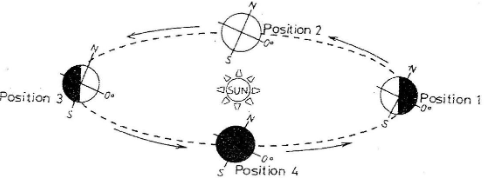
(i) Which movement of the earth is represented by the diagram? (1mk)
• Earth revolution
(ii) Give two effects of the movement represented by the diagram (2mks)
• Causes changes in position of midday sun at different times of the year.
• Causes varying length of the days and nights in northern and southern hemisphere.
• Causes changes in seasons, spring, summer, autumn and winter.
• Causes lunar eclipse
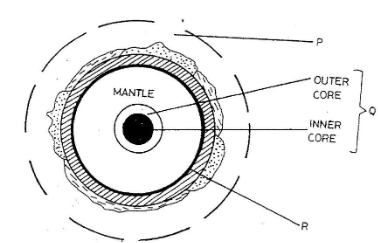
2. The diagram below represents the structure of the earth. Use it to answer question
a) Name
(i) The parts marked P and Q (2mks)
P - Atmosphere
Q - Barysphere/centrosphere/core
(ii) The discontinuity marked R (1mk)
R -Mohorovicic discontinuity/moho dicontinuity
(b) State three characteristics of the mantle (3mks)
• Divided into two-upper and lower mantle
• Mantles' main constituent minerals are ferro-magnesium and silicate.
• Mantle is about 2, 900 km thick.
• Upper mantle has low temperature than lower mantle.
• Mantle has temperatures of about 1000°C.
• Mantle is made up heavier rocks than rocks of earth crust.
• Upper mantle is made up of an elastic solid/semi-molten
• Inner mantle is made up an elastic solid/semi molten basic rocks/ viscous liquid.
3. The diagram below shows the composition of the solar system
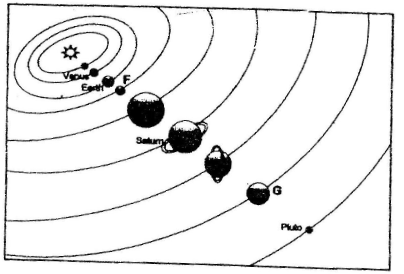
(a) Name the planets marked F and G (2mks)
F -Mars •
G -Neptune
4. a) What is the solar system?
-Solar system refers to the composition of the sun, the planets and other heavenly bodies related to the sun.
b) Use the diagram below to answer the questions that follow.
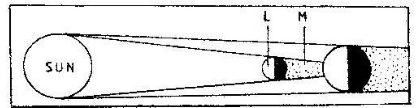
i) What type of eclipse is represented by the diagram?
Solar eclipse
ii) Name the features marked L and M
L - Moon
M- Shadow
5. (a) (i) Give the two dates in a year during which the number of hours of darkness is equal in both the north and south poles.
-21st March and 23rd September
(ii) Why do the lengths of days and nights vary from one part of the earth to
-Due to revolution of the earth.
6. Define the following,
i. Solar system
Organization made up of the sun with the nine planets orbiting around it and heavenly bodies,
ii. Galaxy
Group/cluster of stars in the universe.
iii. Star
Star - Hot mass of glowing gases that transmit light to outer bodies.
iv. Asteroids (6mks)
Asteroid - Small planet-like objects orbiting around the sun between the planets of Mars and Jupiter.
7. Differentiate between the following
(a) Latitude and longitude
-Latitude is the distance north or south of equator measured as an angle from the earth's centre while longitude is the distance of the earth's surface measured east or west of prime meridian and expressed as an angle.
-Latitude is imaginary line running from East to West showing how far North or South a place is from Equator.
(b) Dateline and international dateline
• Dateline is line 180° at which a day is lost or gained while international dateline is zigzag line along longitude 180° deviating land surfaces and at which day is lost or gained.
(c) Meteors and Meteorite. (6mks)
• Glowing objects that quickly cross the sky before they burn up and disappear while meteorites are those meteors that pass through the atmosphere brightly but do not burn up.
8. State three differences between solar eclipse and lunar eclipse.(2mks)
• In solar eclipse moon lie between sun and earth while in lunar eclipse earth lie between moon and sun.
• In solar eclipse shadow of moon is cast on earth while in lunar eclipse shadow of earth is cast on moon.
• Solar eclipse occurs during the day while lunar eclipse occurs during the night.
• Lunar eclipse is caused by earth's revolution while solar eclipse is caused by revolution of moon.
9. State four factors that support life on planet earth. (4mks)
• Presence of water that support life.
• Presence of atmosphere with adequate O2 and CO2 levels that support life of animals and plants respectively.
• Enough heat and light due to earth's favourable distance from the sun.
• Proportional gravitational force that allow objects to be upright on the earth's surface.
10. (a) List four effects of earth rotation. (4mks)
• Causes deflection of the winds
• Causes time difference between Meridians.
• Causes variation in speed of air masses.
• Causes rising and falling of ocean currents.
• Causes variation in atmospheric pressure.
(b) At Nairobi on longitude 37°E local time is 1 p.m. What time would it be at Sarissa on longitude 41 °E? (4mks)
G.M East
34°E 41°E
1 p.m. ?
1° = 4 minutes
4 x 4 = 16 minutes
Local time -1.00pm +16 minutes= 1.16 p.m.
11. (a) Define equinox. (2mks)
Periods 21st March and 23rd September when the sun is overhead at midday along the equator.
(b) State characteristics of summer solstice. (4mks)
• Sun is overhead at mid-day along the tropic of cancer/Capricorn.
• Days are longer than nights.
• Temperatures are high in the region experiencing summer solstice.
• 24 hour sunshine within the circles.
12. The earth is inclined to the ecliptic plane at an angle of..1... and the axis is also inclined at an angle ...2.. to perpendicular line. (4mks)
1-66 ½
2 23 ½
13. Fill in the table from (a) - (f) (10mks)
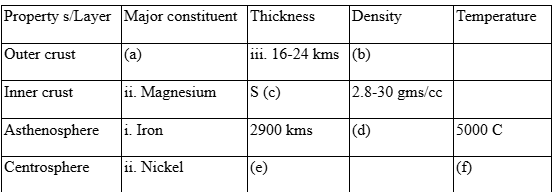
aSilica, aluminium
b 2.7 gms/cc
c 6 -10 kms
d 3.0-3.3 gms/cc
e 3470 kms
f 5,500 cc 14.
14. State three weaknesses of the passing star theory. (6mks)
• Chances of another star approaching the sun are minimal.
• High temperature materials drawn from the sun would disperse rather than condense.
• It does not explain where the sun and the star came from.
15. Differentiate between hydrosphere and atmosphere. (4mks)
Hydrosphere is part of the earth surface covered by water masses e.g. oceans, seas, rivers and swamps while atmosphere refers to thin layer of gases surrounding the earth and held by earth's gravitational pull.
16. Planet ... 1... is seventh planet from the sun and is greenish in colour. Planet ...2... takes shortest time to revolve round the sun about 88 earth day. Planet ...3... and ...4... are referred to as twin planets. Planet ...5... takes about 11.86 earth years to revolve round the sun. All the planets have satellite orbiting round them except planet ...6... and ...7... (7mks)
1. Uranus
2. Venus
3. Earth
4. Venus
5. Jupiter
6. Venus
7. Mercury
17. Explain reasons for flattening and bulging of earth. (4mks)
• Earth rotates on its own axis to make a complete turn; and its poles rotate of this axis and pulled towards each other (centripetal forces)
• Equator covers a long distance and therefore rotates faster, with more speed causing a flinging force (centrifugal force).
18. State characteristics of winter solstice (4mks)
• Low temperatures
• Longer night times than day times at latitudes beyond equator
• The sun is overhead Tropic of Capricorn on 22nd December and its winter Solstice in the Northern Hemisphere.
• On 21st June the sun is directly overhead the Tropic of Cancer and its winter solstice is in the Southern hemisphere.
• Sun is not visible at cycles and there is darkness for 24 hrs.
19. Differentiate between summer solstice and winter solstice. (4mks)
• Winter solstice occurs on 22nd December and 21st June when the sun is overhead at mid-day along tropic of Capricorn and Cancer respectively. At the Arctic Circle and Antarctic circles the sun is visible for only a few minutes when it appears above the southern/ Northern horizon.
• Summer solstice occurs on 21st June and 22nd December when the sun is overhead in the tropic of Cancer and Capricorn respectively. The sun rises higher in the sky and is visible for 24 hrs at the arctic and Antarctic cycles.
20. (a) What is an eclipse? (2mks)
It is a shadow that is formed when rays of the sun are blocked from reaching the earth or the moon.
21. Apart from planets name other heavenly bodies.
• Comets
• Asteroids
• Meteorites
• Satellites
22. What is a longitude? (2mks)
21. • It is an imaginary line running from North to South that shows how far east and West a place is from the Greenwich prime meridian.
• It refers to angular distance east or west of the Greenwich prime meridian.
23. State the effects of the elliptical shape of the earth's orbit. (6mks)
• It causes aphelion whereby the earth is sometimes in its farthest position from the sun.
• It causes perihelion whereby the sun is sometime at its closest position to the sun.
• It influences the occurrence of spring and neap tides.
• It changes cycle of equinoxes and solstices
• It influences occurrence of seasons
24. If the local time in Nairobi on longitude 37°E time is 10 p.m. What will the time be at Buchanan Liberia on longitude 10°W.? (4mks)
1° - 4 minutes
47° x 4 = 188 minutes
188 minutes = 3 hrs 8 minutes
Buchanan is 3 hrs 8 minutes behind Nairobi. 10.00 pm-3hrs 8 minutes
=6.52 p.m.
(a) What is the effect of International Date Line on crossing the line? (4mks)
On crossing this longitude while going to the West, a day is gained and white crossing to the East a day is lost.
(b) What is the angle of inclination of the earth axis from its orbit? (2mks)
661/2°
(c) Give four proofs that the earth is spherical in shape. (8mks)
Photographs taken from the outer space or satellites show the curvature of the earth.
• During eclipse of the moon, the earth casts a spherical-shaped shadow on the moon.
• Circumnavigation of the earth along a straight path will bring one back.
• Earths horizon occurs curved• Other planets are spherical, and earth is one of planets.
• Different rising and setting times in different places.
• Gradual appearance of an approaching ship.